The Home Depot: Simplifying the Online HVAC and Window Lead Form
Role: Analyst · Timeline: 3 months · Outcome: Single-step lead form implemented for HVAC and Window Installation and Repair pages
Project Context
Navigating the HVAC installation process online can be overwhelming for customers, especially when they face lengthy, multi-step lead forms. This complexity often leads to frustration and drop-off, making it harder for users to complete their requests. To address this, I helped plan and conduct a usability study comparing the current multi-step lead form with a simplified single-step version. The goal was to evaluate whether the new layout could reduce friction, clarify expectations, and improve overall usability.
My Role
Worked with the UX research team with consistent feedback and support. My responsibilities included:
Drafted the research plan and usability test guide
Gathered and reviewed existing HVAC form research
Created participant scenarios for realistic task completion
Moderated live usability testing sessions
Synthesized participant feedback using affinity mapping in Miro
Research Timeline
The project spanned three months. It began with a research kickoff, after which I developed a detailed project plan. I then wrote the research guide, reviewed prior research on HVAC lead forms, and crafted participant scenarios. Next, I moderated usability tests comparing the current multi-step form with the new single-step design. The project concluded with a synthesis phase, where I organized findings through affinity mapping to identify key insights and user preferences.

Research Project Timeline (Click on the image to view the Miro board)
Research Testing Plan
Research Goals
Evaluate participant expectations of the CTA language, “Get a Quote” vs. “Free In-Home Consultation”
Identify pain points with the current multi-step lead form
Test the usability of a single-step lead form
Identify which lead form users prefer
Methodology
Participants were tasked with completing two versions of the HVAC lead form on a mobile device
Participants
Six participants were recruited through UserTesting.com
Each test lasted 30 minutes
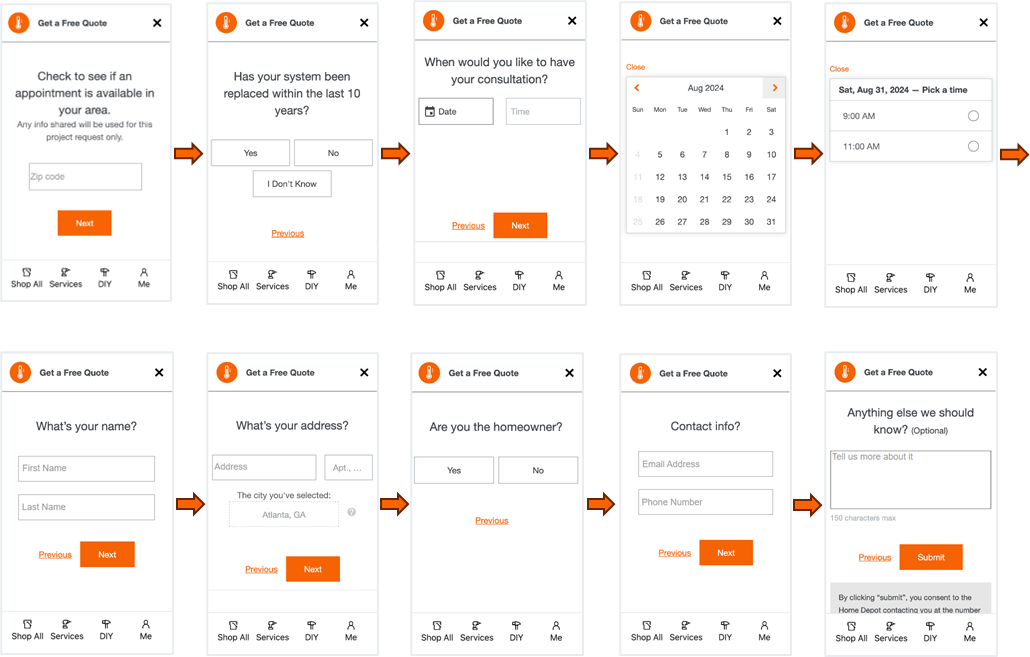
Multi-step HVAC lead form on mobile, with questions spread across several screens.

Single-step HVAC lead form on mobile, with all questions on one page.
Tools and Platforms
The project leveraged several key tools and platforms:
Prototypes: The research team built the test prototypes; I created the visuals shown here to illustrate both flows.
Usertesting.com: Used to conduct moderated tests with participants, providing a platform for capturing real-time feedback on both form layouts.
Miro: Used to create affinity maps, organizing participant feedback into clear, actionable insights.
Presentation Tools: Utilized to create a deck summarizing the research findings.

Affinity map I created in Miro to synthesize user feedback
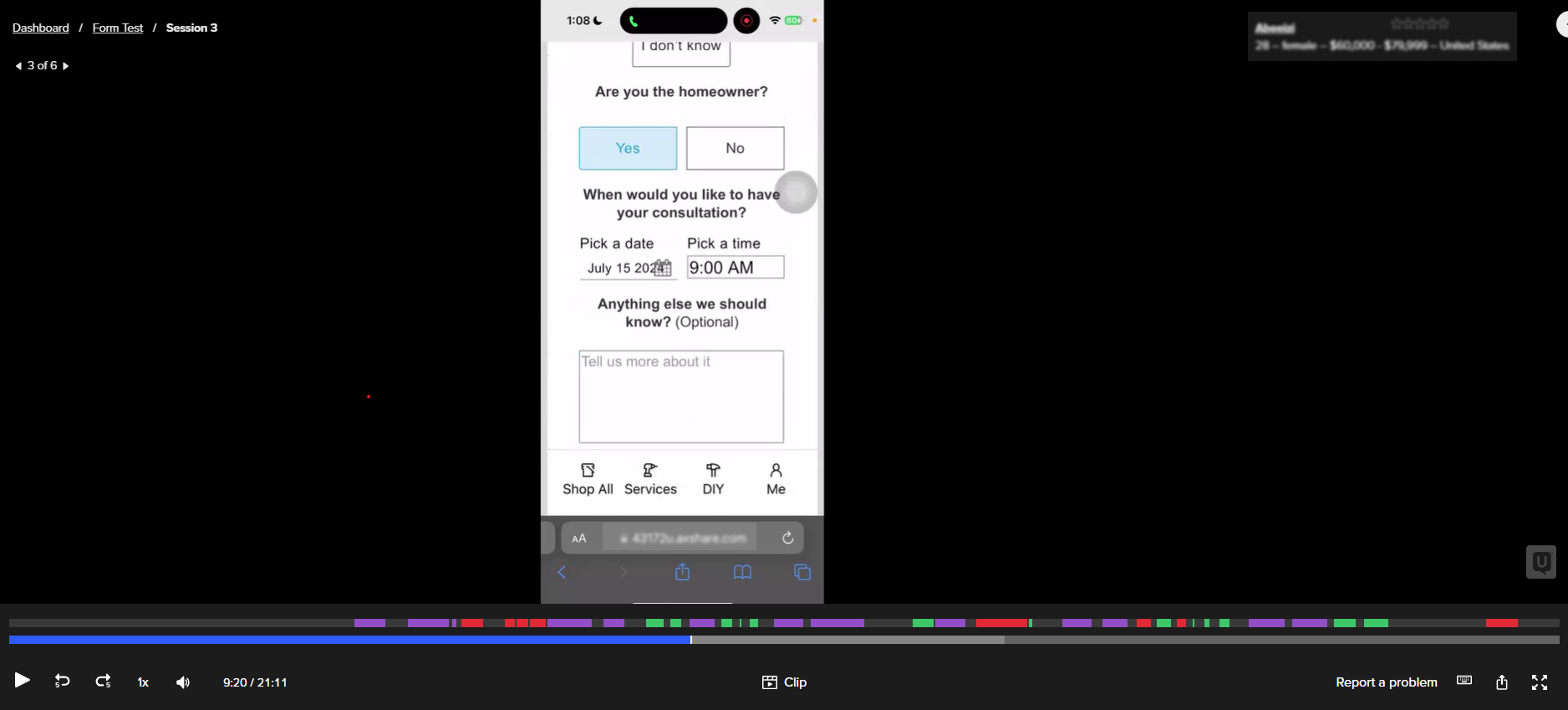
Participant 2 walking through the one-step form prototype (UserTesting.com)
What I Learned
After testing both prototypes, I synthesized participant feedback through affinity mapping and identified the following insights.
Multi-step Form (Current)
Participants found the form long and felt unsure of how much was left.
Some questions felt repetitive or unnecessary.
The CTA language “Get a Quote” caused some confusion about what would happen next.
Single-step Form (New)
Participants liked seeing all questions at once and felt more in control.
The layout helped them understand what information was needed upfront.
“Free In-Home Consultation” felt more transparent and service-oriented than “Get a Quote.”
Form Preference
5 out of 6 participants preferred the single-step form for its transparency and perceived ease.
Participants expressed more trust in the experience when the steps were visible from the start.
Outcome & Business Impact
Based on my findings, I recommended implementing the single-step lead form for both HVAC and Windows, and the team implemented it on both. In my findings presentation, I showed stakeholders that the multi-step form was creating uncertainty and friction. Users didn’t know how much was left, questions felt repetitive, and the CTA left them unsure of what would happen next.
By adopting a single-step form that shows all requirements upfront, The Home Depot aims to:
Reduce form abandonment by removing the uncertainty that caused users to drop off mid-process
Increase qualified leads for HVAC and windows by making the request process faster and easier to complete on mobile
Build customer trust early by setting clear expectations before a consultation is booked
This project showed how targeted usability testing with a small group of participants can directly inform product decisions and support business goals around lead generation.